
Introduction
Working on top of road tankers is a routine requirement at many loading and unloading facilities, whether opening a tanker hatch, checking a manway, taking a sample or connecting loading equipment. Yet each time an operator climbs onto a road tanker, the work introduces the possibility of a fall from height. The height and curved profile of the vehicle, wet or contaminated surfaces, changing tanker designs and the movements of other vehicles can make a familiar job hazardous.
For loading and unloading sites, protecting people involves more than supplying a ladder or asking drivers to wear a harness. Site operators have responsibilities for the safety of people working on their premises, including visiting tanker drivers, and should ensure that suitable access and fall prevention measures are available. Relying on ladders and handrails fitted to visiting vehicles can introduce uncertainty about their condition, maintenance and suitability for the task. A safer approach begins with understanding the operation, recognising the responsibilities of everyone involved and applying the hierarchy of controls set out in UK work-at-height guidance.
This guide explains the main risks, the regulatory framework and the practical access and fall prevention options available to operators of road tanker facilities.
What is the safest way to work on top of a road tanker?
The safest approach is to avoid working at height wherever reasonably practicable, for example through bottom loading or ground-level operations. Where tanker-top access is unavoidable, collective fall prevention systems, such as guarded access gantries, folding stairs and safety cages, should generally be prioritised over personal fall protection equipment. Suitable arrangements must be based on the specific task, vehicle and loading site.
1. Why working on top of road tankers is hazardous
Tanker-top access may be necessary for filling, venting, sampling, inspection, cleaning or maintenance. Unlike a fixed workplace, however, a loading bay may receive vehicles of different heights, lengths and top arrangements. The same access method may not safely suit every tanker.
A suitable assessment should consider:
- Falls from ladders, walkways, manways and unprotected tanker edges.
- Slips and trips caused by rain, ice, product residue, hoses and uneven surfaces.
- Gaps between a fixed gantry, access equipment and the vehicle.
- Different tanker dimensions, fittings and the location of work points.
- Unexpected vehicle movement or drive-off while people or equipment remain connected.
- Exposure to hazardous substances and other loading or unloading hazards.
- Conditions during night working, poor visibility and adverse weather.
The objective should be to make access, the working position and the route back to ground level safe, not simply to reduce the severity of an accident after it occurs.
Why routine tasks can become high-risk tasks
The duration of a task is not a reliable indicator of its risk. An operator may be at height for only a minute to open a hatch, but the climb, transfer onto a curved tank and subsequent return can create several separate opportunities for a fall. Repetition can also normalise an unsafe shortcut: a familiar ladder or an unguarded walkway may appear acceptable simply because it has been used many times without incident.
Conditions can change between visits. Water, frost, product residue or cleaning chemicals may affect footholds and grip; wind can make the transition from a platform more difficult; and poor lighting can conceal a change in level. Fittings, hoses and raised manway covers can introduce trip hazards even where the top surface appears relatively clear. Risk assessments should therefore consider foreseeable variations, not only the best conditions on a dry day.
A further complication is that road tankers are not uniform. Vehicle height can change with suspension position and loading condition. Hatch positions, walkways, compartments, guardrail arrangements and the clearance around top-mounted equipment also vary. A system that works well with the site’s most common vehicle may leave a dangerous gap or an inaccessible fitting when a different tanker arrives.
Consider the complete journey, not just the working position
Good fall prevention protects each stage of the task: reaching the access point, climbing, crossing from the structure onto the vehicle, moving to the fitting, completing the activity and returning safely. A cage over the hatch is of limited value if the worker must cross an exposed area to reach it. Equally, a safe gantry may not remove the risk created by an improvised final step between the platform and tanker.
Risk controls should also account for people working below. Dropped tools, hoses, opened fittings or an unexpected release of product may endanger colleagues or visitors in the vicinity. Safe tanker access is one part of a wider loading-bay safety system that also addresses traffic, isolation, spillage and communication.
2. UK law and responsibilities at tanker loading sites
The Health and Safety at Work etc. Act 1974 establishes broad duties to protect employees and others affected by work activities, so far as is reasonably practicable. The Management of Health and Safety at Work Regulations 1999 require suitable and sufficient risk assessment and arrangements for managing risk. The Work at Height Regulations 2005 add specific duties for the planning, supervision, competence, selection of equipment, inspection and safe execution of work at height.
The Regulations apply wherever someone could fall a distance liable to cause personal injury; there is no general two-metre threshold below which the requirements disappear. The precise measures needed depend on the task and the risks identified.
Shared responsibilities: site operators, carriers and drivers
At a tanker loading or unloading facility, the site operator has an important responsibility to ensure that work carried out on its premises can be undertaken safely. This includes activities performed by visiting tanker drivers, not just employees of the site itself.
IFC Inflow’s recommended approach is that loading and unloading sites should provide suitable access and fall prevention arrangements for routine tanker-top operations, rather than relying solely on equipment fitted to visiting vehicles.
Although tankers may be equipped with access ladders, walkways and collapsible handrails, the site operator may have limited knowledge of their inspection history, maintenance or suitability for the task. Without appropriate checks and assurance, it can be difficult to establish whether that equipment provides an adequate level of protection.
This does not remove the responsibilities of the carrier or driver. Both the carrier and the site operator may have duties under health and safety legislation and should cooperate to ensure that their procedures are compatible. Responsibilities should be clearly established for authorising tanker-top access, providing and inspecting equipment, confirming operator competence, securing the vehicle and responding to emergencies.
Site operators should also ensure that equipment used during loading and unloading, including relevant valves, connections and couplings, is suitable for the operation and maintained in a safe condition. The precise arrangements will depend on the activities undertaken and the responsibilities of the parties involved.
What an agreed safe system of work looks like
For a site receiving third-party tankers, it is useful to decide the access arrangements before the vehicle arrives. The carrier should understand the site’s restrictions, including whether tanker-top work is permitted, whether particular equipment is required and how exceptional tasks will be handled. On arrival, the driver needs clear instructions about the bay, vehicle positioning, who controls the operation and who to contact if the planned method cannot be used.
The site operator should have a way to identify a vehicle that cannot be safely accommodated by its standard equipment. This might involve checking the access envelope, hatch location or compatibility with a deployed cage. Work should not proceed merely because a delivery is scheduled or waiting time is increasing. Where the normal method is unsuitable, the parties need an alternative risk-assessed arrangement or the task should be stopped until safe arrangements can be made.
A simple responsibility matrix can be helpful: who provides the access equipment, who checks it, who operates it, who authorises loading, who controls vehicle movement, and who acts in an emergency. The answer will depend on the site and contractual arrangements, so it is the coordination that matters rather than an assumed universal division of duties.
HSE guidance on loading and unloading emphasises that businesses involved should agree how work is carried out in advance. It also highlights safeguards against premature drive-away, such as positive release arrangements, vehicle restraints or other controls suited to the circumstances. These measures should form part of the same operating procedure as tanker-top access.
3. The hierarchy of control: avoid, prevent, minimise
The HSE’s approach provides the starting point for choosing how a tanker-top task should be undertaken. The measures are not equal alternatives: move to a lower level only when measures higher in the hierarchy are not reasonably practicable.
| Priority | Principle | Tanker loading example |
|---|---|---|
| 1 — Avoid | Remove the need to work at height | Bottom loading, ground-level controls or relocated sampling points where suitable |
| 2 — Prevent (collective) | Prevent a fall for everyone in the protected area | Fixed gantries, protected stairs, safety cages or suitable guarded mobile access |
| 3 — Prevent (personal) | Prevent an individual reaching a fall position | Correctly designed and used work-restraint system |
| 4 — Minimise consequences | Limit fall distance and injury where a fall cannot be prevented | Suitable fall-arrest system with planned rescue |
Collective protection, such as a properly designed guardrail or safety cage, protects people within the designated working area without relying on each operator correctly attaching personal fall protection equipment. This is why collective measures should generally be considered before personal systems. Personal fall protection also introduces additional requirements for equipment inspection, maintenance, user competence and, where a fall could result in suspension, suitable emergency rescue arrangements.
Why the order matters in a real loading bay
Imagine a site where an operator climbs onto each tanker to open a top hatch. The first question is whether the operation or fitting can be changed so that access is not needed. If not, the next option is to provide a guarded route and a protected working area that prevents a fall. Only where prevention is not reasonably practicable should a system that mitigates the consequences of a fall become the primary control.
This distinction matters because fall arrest can still involve an injury, an emergency rescue and the interruption of operations. Collective prevention, when correctly designed and used, aims to keep the operator away from the fall hazard throughout the task. It can also reduce reliance on an individual remembering to clip on, choosing the correct anchor and maintaining the correct lanyard arrangement on every visit.
The hierarchy is not a reason to overlook training, supervision or inspection. Those measures remain necessary at every level. Rather, it provides a disciplined method for deciding which physical controls should come first.
4. First choice: eliminate the need to work on top of the tanker
The most effective way to control the risk of falling from a tanker is not to send someone onto it in the first place. A review of the operation may reveal tasks that could be completed from ground level or by changing the loading process.
Bottom loading can remove or substantially reduce routine tanker-top access for compatible products and vehicle configurations. It may also support more efficient loading operations, although conversion must account for the product, vehicle fleet, connections, vapour management, overfill protection, site infrastructure and operating procedures.
IFC Inflow offers a range of liquid-transfer solutions, including PetroLoad and ChemLoad bottom loading arms, loading skids and hose loading systems. These may provide suitable alternatives to top loading where the product, tanker configuration and site infrastructure allow, although the most appropriate approach should always be determined through an assessment of the individual operation.
Even where bottom loading is adopted, some tanker-top tasks, such as inspection, maintenance or venting, may remain. Those activities still require suitable safe-access arrangements.
Assessing whether a change to bottom loading is practical
A conversion to bottom loading is an engineering and operational decision, not simply a matter of replacing one type of loading equipment with another. Sites need to consider the products handled, tanker connections, filling rates, site pipework, earthing and bonding arrangements where applicable, overfill protection, vapour management, spill containment and any product-specific requirements. The tanker fleet must also be compatible with the proposed method.
It may be most realistic to evaluate conversion during a loading-bay upgrade, expansion or fleet change. A phased approach may also be necessary where both top- and bottom-loading vehicles are received. In those circumstances, the site still needs safe top access for the remaining operations; a future plan to eliminate the task does not remove today’s duty to control it.
A useful starting exercise is to list every occasion on which a person climbs onto a tanker and ask why. Some activities may be reduced by redesigning a sampling point, changing a level-checking process or relocating a control. The outcome may be a combination of ground-level improvements and fall prevention equipment rather than a single all-or-nothing solution.
5. Where access is unavoidable: collective fall prevention
If operators must reach a tanker top, the next question is how to create a protected route to the work area and a protected place in which to work. A combination of access structures, stairs and surrounding edge protection may be appropriate.
Fixed tanker access gantries
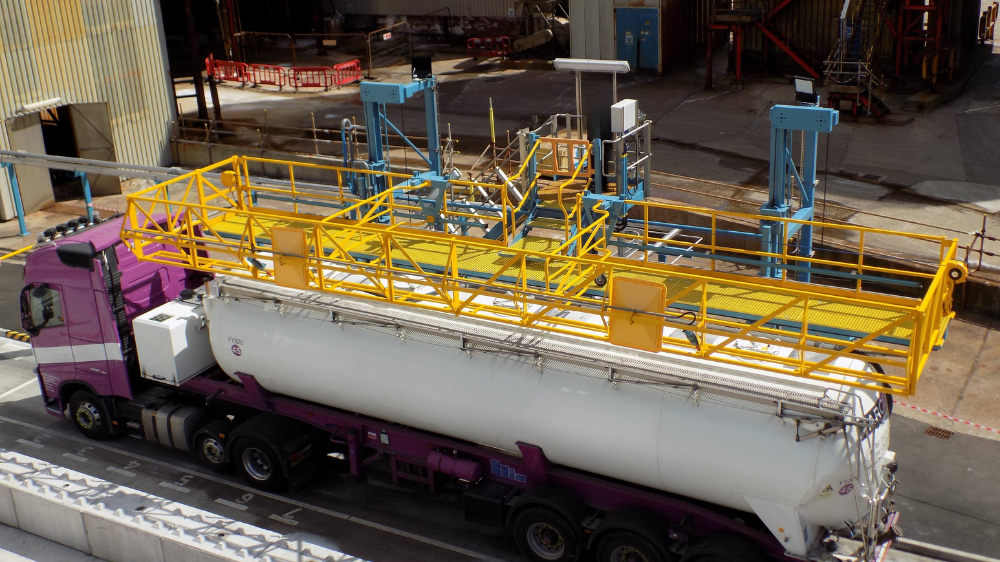
A fixed gantry provides a stable access point and a mounting location for fall prevention and loading equipment. It can be designed for regular work at a fixed bay, with stairs, guarded platforms and access arrangements adapted to the site layout and vehicle fleet. Consideration should be given to working height, reach, clearances, tanker alignment, pedestrian routes and the way vehicles are positioned and secured.
IFC designs fixed tanker loading gantries, including compact platforms and larger bespoke systems for operations requiring access to multiple points.
For a busy facility, the strength of a fixed installation is consistency: operators can be directed to a defined access point, with stairs and guards forming part of a repeatable procedure. That consistency depends on careful design. The structure should account for the vehicle approach route, working height, usable platform space, position of the loading equipment, safe escape route and the range of tankers likely to be present.
A design should also consider what happens when equipment is not in use. Folding stairs, cages and loading arms may need to be stowed before a vehicle can move. Visibility, clear operating instructions and suitably designed controls or interlocks can help prevent equipment being struck or damaged. The choice of such controls should follow the site-specific risk assessment.
Explore our Fixed Tanker Gantries.
Folding stairs and safe transfer
Folding stairs bridge the gap between a fixed access platform and the tanker. Properly selected self-levelling steps can help provide a more secure transition than an improvised ladder arrangement. They need to suit the range of tanker heights and be positioned and maintained in accordance with their design.
IFC’s FlowStep folding stairs are one option for installations where operators move between a fixed gantry and a tanker-top working area.
The transfer point deserves particular attention because it is where a stable structure meets a vehicle that may sit at a different height each time. Stairs need sufficient adjustment, an appropriate landing arrangement, stable steps and protection against unguarded side gaps. A change in vehicle position or ride height can alter the geometry after the equipment has been deployed.
The safest arrangement should also be straightforward to operate. If it is awkward to deploy or leaves a difficult last step, users may be tempted to bypass it. Checking operation with representative tankers, rather than dimensions alone, can reveal practical issues before a new system is commissioned.
Safety cages and enclosed work areas
Safety cages provide collective edge protection around a defined working zone. They can allow operators to reach hatches or fittings while remaining within a guarded area. Size, orientation, deployment method and compatibility with different vehicles and loading equipment are important design considerations.
IFC’s Total Tanker Safety Cages (TTSC), VertiLev and MultiLev systems offer different approaches to providing collective fall prevention. The most suitable solution depends on the access requirements, the size and configuration of the tanker, and whether the operation requires protection around a specific working area or access to multiple points.
The correct cage arrangement depends on the size of the zone that needs protection. One task may require access to a single manway; another may involve several compartments or fittings spaced along the tank. Protecting only the immediate hatch opening will not be sufficient if the operator needs to move outside that protected area to complete the work.
The interface with hoses, top-loading arms, hatch covers and other equipment also matters. Guards should protect against falls without creating new pinch points, obstructing a safe escape route or encouraging an operator to lean beyond the protected zone. The deployment sequence, visual checks and safe stowage position should be built into the operating procedure.
Mobile access platforms
A fixed platform is not always the right answer. Sites with infrequent operations, changing loading points or limited fixed infrastructure may need a properly selected mobile solution. The platform must offer appropriate stability, guarded access and compatibility with the task and surface; temporary use does not mean the risk can be treated as minor.
IFC’s TopTank provides mobile access for tanker-top tasks and incorporates a fall prevention cage. LowTank addresses lower-level tanker access applications. Their suitability should be checked against the actual site and vehicle requirements.
Mobility offers flexibility but requires discipline. Before use, a mobile platform may need a level and suitable surface, correct positioning, securement or braking, and confirmation that its access zone aligns with the task. Its movement route also needs to be managed so it does not conflict with vehicles, pedestrians or overhead services.
Mobile access should therefore be selected for a defined operational need, rather than assumed to be a universal replacement for a fixed gantry. It can be valuable for intermittent work, varying locations or facilities where permanent steelwork is not justified, provided the resulting method supplies effective protection for the whole activity.
Explore our Mobile Access Platforms.
6. Work restraint and fall arrest: understanding the distinction
Work restraint and fall arrest both use personal equipment, but they serve different purposes. A properly designed restraint system prevents someone reaching a position from which they could fall. A fall-arrest system permits the possibility of a fall but aims to stop it and limit its consequences. Neither should be mistaken for a replacement for reasonably practicable collective protection.
| Method | What it does | Key consideration |
|---|---|---|
| Collective fall prevention | Protects the guarded work area and users within it | Needs suitable geometry and full protection of relevant edges and transfer points |
| Work restraint | Prevents the user reaching a fall position | Length, anchorage, connection and work range must be correctly engineered |
| Fall arrest | Stops a fall after it starts | Requires suitable anchorage, clearance, compatible equipment and prompt rescue arrangements |
A harness alone does not make work at height safe. The whole system, including anchors, connectors, lanyards, clearance, training, supervision and recovery provisions, must be suitable for the work. A restraint arrangement must not inadvertently allow a fall; if it does, its design and equipment requirements change.
Inspection, maintenance and rescue
Users should carry out checks of personal fall protection equipment before each use and remove defective equipment from service. Formal, recorded inspections should also be carried out by a competent person at intervals appropriate to the equipment, its use and the working environment. HSE guidance recommends detailed harness inspections at least every six months, with more frequent checks where particularly demanding conditions or exposure to hazardous substances justify them. Manufacturer instructions and applicable inspection requirements should always be followed.
Chemical contamination is especially relevant at bulk liquid sites: webbing, connectors and stitching can deteriorate in ways that may not be immediately obvious. Suspected damage or contamination should be dealt with in accordance with the manufacturer’s instructions and competent advice.
Where fall arrest is used, a suitable rescue plan is essential before work begins. It should identify how a suspended person will be recovered promptly, by whom, using which equipment, and how the arrangements will be rehearsed. Simply assuming emergency services will carry out the rescue is not adequate planning.
IFC Inflow’s approach focuses on preventing falls wherever reasonably practicable, using appropriate access equipment and collective protection systems. Understanding the limitations of work restraint and fall arrest helps explain why prevention should be the preferred approach when designing safe tanker access arrangements.
Building rescue arrangements into the plan
A rescue procedure needs to be credible for the specific location. It should take account of the height, access restrictions, number of people available, communications, potential exposure to product and the type of equipment in use. Personnel expected to carry out the rescue should be competent and able to access the necessary equipment without exposing themselves to an uncontrolled fall risk.
Suspension following an arrested fall is time-critical, but rescuers should not improvise unsafe methods. The response should be planned, practised where appropriate and reviewed whenever the equipment, site layout or staffing changes. This is another reason why eliminating the need to work at height and preventing a fall are preferred wherever reasonably practicable.
7. Tanker-mounted ladders, walkways and handrails
Vehicle-mounted access equipment can form part of a safe system, but it brings particular challenges when different tankers visit the same location. A fitted ladder may give access to a narrow walkway with incomplete edge protection, while collapsible handrails can conflict with overhead structures or other loading equipment.
Site managers should consider the condition and positioning of ladders, the security of steps and handholds, slip resistance and obstruction-free access, the integrity and coverage of walkways, and whether handrails protect all relevant exposed edges. It is equally important to check whether access remains safe while a hatch is opened or a hose or loading arm is moved.
Vehicle designs and applicable standards vary, so the suitability of tanker-mounted ladders, walkways and handrails must be assessed for the specific task and operating environment. Their presence on a tanker does not automatically mean they provide adequate protection for every activity undertaken at a loading or unloading site.
Why vehicle-mounted protection needs careful assessment
Tank-mounted ladders and handrails can be useful, particularly away from a purpose-built loading facility, but their condition and geometry vary. A ladder may be serviceable while the transition onto the top walkway remains exposed. A handrail may protect one edge but leave gaps around a hatch, the access point or the ends of a walkway. The presence of a rail does not necessarily establish that the whole operation is protected.
Collapsible handrails also introduce an operational interaction: they may need raising before access and lowering before departure. Overhead pipework, gantries and other structures can limit clearance. Any safe system relying on vehicle-mounted rails must consider whether they can be fully deployed at that specific bay, as well as how their condition will be checked.
For site operators, a particular challenge is establishing whether tanker-mounted equipment has been adequately inspected and maintained. Different vehicles may arrive with different access arrangements, and the condition of those systems may not be readily verifiable. IFC Inflow therefore recommends that sites consider purpose-designed access and fall prevention equipment under their own control, rather than relying on visiting vehicles’ equipment as the primary means of protection for routine tanker-top operations.
This approach can provide a more consistent standard of access and protection, while allowing equipment inspection, maintenance and operating procedures to be managed as part of the site’s overall safety arrangements.
8. Choosing a suitable tanker access solution
Selection should follow an assessment of what happens in the bay rather than starting with a catalogue product. In practice, a small number of questions can narrow down the options:
- Can any tanker-top tasks be eliminated or relocated to ground level?
- How frequently is top access required, and for how long?
- Will the site receive one standard tanker design or a mixed fleet?
- Where are the hatches, manways, sample points and other task locations?
- Would a fixed gantry provide the most reliable access, or is mobile equipment needed?
- Can a guard or cage cover the full working area without obstructing loading equipment?
- How will operators be prevented from accessing an unprotected position or moving the vehicle at the wrong time?
- Who will inspect, maintain and operate the installation, and how will its use be documented?
For example, a busy loading bay with repeatable tanker positions may benefit from a fixed gantry, FlowStep stairs and an enclosed cage. A constrained site with varying tanker heights may need a more tailored solution. In some operations, a VertiLev or MultiLev system, or a modified loading process, may reduce the need for operators to step directly onto the tanker.
These are illustrations rather than a specification. Any proposed solution must be checked against the relevant vehicles, tasks, site conditions and risks.
Designing access around operational efficiency
A good tanker access installation should protect the operator without introducing unnecessary complications into the loading process. If a worker has to reposition a platform repeatedly, climb down to retrieve a tool or lean awkwardly to reach an instrument, the installation may not adequately reflect the work being done. Understanding the sequence of tasks is therefore as important as understanding the vehicle dimensions.
Before selecting a solution, it can be useful to observe several typical loading or unloading cycles. Where does the driver stop? Who verifies the vehicle? Which fittings are accessed and in what order? How long are operators at height? Does equipment need to be repositioned between compartments? What happens if a different tanker arrives or an operation is interrupted? Answers to these questions can improve both the safety concept and the working arrangement.
Facilities may also need to support simultaneous or adjacent operations. Access structures should be considered alongside loading arms, hose management, traffic routes, maintenance access, emergency egress and future equipment upgrades. A design that considers only the immediate hatch location may prove restrictive when the bay is used in practice.
The commercial value of better access should not be reduced to an unsupported promise of faster loading. Potential benefits include more repeatable working methods, fewer improvised movements, simpler staff training and improved access for inspection. Whether a particular solution reduces turnaround time, downtime or other costs should be supported by site-specific evidence.
Planning for mixed fleets and future changes
Some sites receive a stable fleet with similar tanker dimensions. Others handle third-party vehicles with different lengths, compartment layouts, suspension heights and access requirements. The design envelope should reflect the vehicles the site actually receives, including foreseeable exceptions, rather than one representative drawing.
It is worth distinguishing the range that a system is designed to accommodate from the range it can cover under all operating conditions. An adjustable platform may reach multiple vehicle heights but still require checks for cage alignment, step geometry and safe working position. Where certain vehicles fall outside the safe range, the operating procedure should make that limitation clear.
Long-term planning also matters. A loading facility may be expected to operate for many years while vehicle fleets, products and throughput change. Allowing for sensible future adjustments, accessible maintenance points and compatibility with other equipment can make a system more useful over its working life.
9. Training, inspection and incident reporting
Suitable equipment is effective only when it is used within a controlled system of work. Drivers and site personnel need clear instructions about arrival, positioning, isolation or movement controls, authorisation to access the tanker, equipment operation and emergency arrangements. People tasked with inspection and maintenance need the competence and information appropriate to those duties.
Inspections should cover the full arrangement, not just the most visible components: platforms and steps, guardrails and cages, hinges and moving parts, controls and interlocks where fitted, anchors where relevant, and any signs of damage or deterioration. The frequency and scope should follow the applicable regulations, risk assessment and manufacturer recommendations.
Near misses and unsafe conditions should be encouraged to be reported and reviewed internally so that controls can be improved. Under RIDDOR 2013, certain work-related deaths, specified injuries, over-seven-day incapacities, diseases and defined dangerous occurrences must be reported to the enforcing authority. Not every minor injury or near miss is RIDDOR-reportable; the applicable criteria must be checked.
Turning procedures into consistent everyday practice
Useful site instructions should be short enough to follow, but specific enough to deal with real decisions. They should describe how a vehicle is positioned and secured, when access equipment may be deployed, who confirms that the working area is protected, what to do if equipment cannot reach safely and how the bay is released when the operation is complete.
Induction alone may not be sufficient for infrequent visitors or temporary drivers. Clearly marked access points, simple diagrams and unambiguous stop-work instructions can help communicate the safe method. Site management should also check that the procedure is being followed in practice, especially after changes to the bay, equipment or tanker fleet.
Maintenance should be proactive. A failed hinge, damaged cage, worn non-slip surface or unserviceable control may turn a normally protected operation into an unsafe one. Defects need a route to prompt reporting, isolation and repair; operators should know what alternative arrangements are permitted, if any. Inspection records, service schedules and follow-up actions provide evidence that equipment is being managed rather than merely installed.
Near-miss reports are particularly valuable where the same site receives many vehicles. Repeated difficulty reaching a hatch, a cage that cannot be fully deployed or a vehicle that has nearly moved with equipment connected can reveal problems before an injury occurs. The purpose of reporting should be practical learning and control improvement, not just completing a form.
10. Practical tanker-top safety checklist
- Have we challenged whether the task needs to be carried out at height?
- Is there a current risk assessment covering the task, tanker and site conditions?
- Are carrier and site operator procedures aligned, with responsibilities understood?
- Is there a safe, unobstructed route to and from the working position?
- Is collective fall prevention provided wherever reasonably practicable?
- Are the selected access and loading systems compatible with the vehicle?
- Are equipment checks, formal inspections and maintenance up to date?
- Are operators trained, authorised and supervised as appropriate?
- Are vehicle movements and any relevant interlocks or permits controlled?
- Are emergency and rescue arrangements practicable and understood?
- Are incidents and near misses recorded, investigated and acted upon?
This checklist is a discussion aid; it does not replace a competent assessment or a formal inspection record.
11. Frequently asked questions
Is a harness enough to work safely on top of a road tanker?
Not by itself. A harness is only one component of a properly designed and managed system. The work-at-height hierarchy requires avoiding the task where possible, then prioritising fall prevention and collective protection before measures that only minimise the consequences of a fall.
Who is responsible when a visiting driver works on top of a tanker?
Both the site operator and the carrier may have legal duties relating to the safety of a visiting tanker driver. IFC Inflow recommends that loading and unloading sites provide suitable safe-access and fall prevention arrangements for tanker-top work, rather than relying solely on equipment fitted to visiting vehicles. The parties should coordinate their responsibilities, including equipment provision, training, operating procedures and emergency arrangements.
What is the difference between fall prevention and fall arrest?
Put simply, fall prevention stops you from falling, while fall arrest catches you if you do. Fall prevention systems, such as guarded access platforms and safety cages, are designed to prevent a fall from occurring. Fall arrest systems act after a fall begins to limit its distance and consequences, and require suitable equipment and planned rescue arrangements.
Can mobile access provide effective fall prevention?
Yes, if the equipment is suitable for the task, correctly positioned and stable, and provides appropriate guarding and safe access. It is particularly relevant where a fixed installation is impractical, but it still needs inspection and a site-specific safe system of work.
Does bottom loading always eliminate working at height?
Not necessarily. It can remove routine tanker-top access associated with certain loading operations, but inspections, cleaning or other tasks may still require access. The whole operating process should be reviewed.
How often should fall-protection harnesses be inspected?
Users should check equipment before use. HSE guidance recommends a formally recorded detailed inspection at least every six months, with more frequent inspection in demanding conditions, subject to manufacturer instructions and the assessment of a competent person.
What should a site assess before installing a tanker access gantry?
The assessment should cover the tasks, expected tanker fleet, range of working heights, access locations, loading equipment, vehicle positioning, pedestrian routes, available space and emergency arrangements. The gantry and any folding stairs or safety cages need to work as one safe system, rather than as separate items.
Can one access system accommodate different road tankers?
Some adjustable systems can accommodate a defined range of heights and configurations, but no solution should be assumed to fit every tanker. Sites should check the proposed operating envelope against actual vehicles, including hatch positions and safe transfer arrangements.
Why is collective fall protection generally preferred?
Collective fall protection, such as a properly designed guardrail or safety cage, protects everyone within the designated working area without relying on individuals wearing and correctly connecting personal fall protection equipment. It can therefore provide a more consistent approach to safety, although appropriate equipment inspection, maintenance, training and operating procedures remain essential.
What if a visiting tanker cannot use the standard site equipment?
The task should not proceed using an improvised access method. The site operator and carrier should reassess the work and agree a suitable safe alternative, or postpone the activity until appropriate controls are available.
Do fall prevention systems need regular maintenance?
Yes. Fixed and mobile equipment should be inspected and maintained according to its design, the manufacturer’s instructions, the risk assessment and the conditions in which it operates. Moving parts, guarding, steps, surfaces and controls all need attention, alongside prompt action on identified defects.
12. A safer approach to tanker access
Working safely on top of road tankers requires more than individual precautions or compliance with basic safety procedures. It demands a considered approach to the entire operation, from identifying whether work at height can be avoided to selecting suitable access equipment, providing effective fall prevention and ensuring that safe working arrangements are consistently maintained.
For loading and unloading sites, this means taking a proactive approach to the safety of everyone working on their premises, including visiting tanker drivers. Rather than relying solely on equipment fitted to individual vehicles, purpose-designed access and collective fall prevention systems can provide a more consistent, controlled and manageable working environment.
Every site presents different challenges. Vehicle configurations, loading processes, available space and operational requirements all influence the most appropriate solution. Understanding those factors is essential to developing arrangements that protect people without unnecessarily complicating everyday operations.
IFC Inflow works with businesses to assess their tanker loading and access requirements, providing solutions ranging from bottom loading systems to fixed gantries, folding stairs, safety cages and mobile access platforms.
By combining practical engineering expertise with an understanding of how tanker loading sites operate, IFC helps businesses develop safer, more efficient and more consistent working environments.
If you’re reviewing the safety of your tanker loading operations or considering improvements to existing access arrangements, contact IFC Inflow to discuss your requirements.