
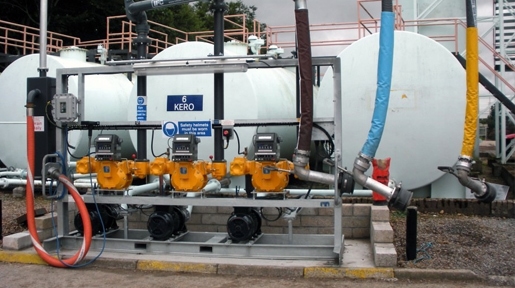
Loading and unloading bulk liquids is an essential operation across the chemical, petroleum, food and beverage, and industrial sectors. Whether transferring fuel into a road tanker, loading chemicals for distribution or refuelling railway equipment, the systems used must be safe, efficient and suited to the products being handled.
Loading arms play a vital role in these operations, providing a controlled and flexible connection between fixed pipework and mobile tanks or equipment. However, not all loading arms are the same. Different products, tanker configurations, operating environments and safety requirements call for different solutions.
This guide explores how loading arms work, the main types available, their applications and the important considerations when selecting the right equipment for a bulk liquid transfer operation.
What is a loading arm?
A loading arm is an engineered pipework assembly designed to transfer liquids between a fixed installation and a road tanker, rail tanker, ISO tank or other receiving vessel.
Unlike rigid, fixed pipework, loading arms incorporate swivel joints that allow them to move horizontally and vertically. This flexibility enables operators to position the loading connection accurately, accommodating differences in vehicle position, filling point location and tanker configuration. Many loading arms also incorporate spring balancing systems, reducing the effort needed to move the equipment and helping operators handle heavy pipework and connections safely.
Loading arms are used for both loading and unloading operations, depending on the design and application. They are widely specified where controlled handling, repeated transfer operations, chemical compatibility or reduced manual handling are important considerations.
How does a loading arm work?
A typical loading arm is connected to a fixed liquid supply or discharge system, usually through a flanged connection. The arm extends towards the tanker or receiving point, with swivel joints allowing the operator to adjust its position. Depending on the configuration, the end connection may comprise a drop pipe, flexible hose, sealed loading connection or specialist coupling.
Once correctly positioned and connected, liquid can be transferred through the arm under the appropriate operating conditions. Several components contribute to the system’s operation:
- Swivel joints provide movement while maintaining a contained liquid flow path.
- Balancing systems help counteract the weight of the arm, making it easier to position.
- Drop pipes or flexible hoses provide the final connection to the receiving vessel.
- Loading valves and couplings allow the transfer operation to be controlled and the connection secured.
- Safety equipment, such as overfill sensors, vapour recovery connections and position switches, can provide additional protection.
The precise configuration depends on the product being transferred, the available loading space and the operational requirements of the site.
Top loading arms vs bottom loading arms: what’s the difference?
One of the most important distinctions is whether liquid is transferred through an opening at the top of a tanker or through a connection at the bottom or side. Both methods are widely used, but their suitability depends on the application.
Top loading arms
Top loading arms transfer liquid through an opening or connection on the top of a tanker. The arm is typically mounted at an elevated position, allowing it to extend over the vehicle and lower a drop pipe or loading connection into position.
Top loading remains important in industries where vehicle configurations, product characteristics or existing infrastructure make it the most appropriate method. Depending on the application, top loading can be carried out through open, semi-enclosed or sealed connections, with equipment that may incorporate vapour control, overfill protection and other safety systems.
Top loading arms are particularly useful when:
- Loading points vary between tanker types or positions.
- A top-fill connection is required by the receiving vessel.
- The product or process requires a specialist drop pipe or loading arrangement.
- Existing site infrastructure is designed around top loading.
- Additional equipment, such as vapour recovery or heating systems, needs to be incorporated.
Where operators must access the top of a tanker, appropriate working-at-height controls are essential. Depending on the installation, these may include access gantries, platforms and tanker fall prevention equipment.
Bottom loading arms
Bottom loading arms transfer liquids through connections located at or near ground level, typically on the side or rear of the tanker. They are widely used in petroleum distribution and chemical transfer applications, where closed connections and ground-level operation can provide significant safety and operational benefits.
Because operators can connect the equipment without climbing onto the tanker, bottom loading reduces the need for working at height during the transfer operation. In suitable installations, several loading arms can also be positioned alongside one another, allowing multiple tanker compartments or products to be handled.
Bottom loading arms are particularly useful when:
- Tankers have compatible ground-level loading connections.
- Working-at-height risks need to be reduced.
- Multiple products or compartments must be loaded.
- Closed transfer connections are required.
- A controlled loading or unloading process is important for hazardous liquids.
- Tankers have suitable overfill protection devices fitted.
Bottom loading is widely established in petroleum distribution, but it is also used for chemicals, solvents, heated products and other industrial liquids.
Top loading vs bottom loading: a comparison
| Consideration | Top loading | Bottom loading |
|---|---|---|
| Connection point | Top of the tanker – typically an open manway | Side, rear or lower-level connection – typically a valve or flange fitting |
| Operator access | May require elevated access | Usually operated at ground level |
| Typical applications | Chemicals, industrial liquids, specialist tanker loading | Petroleum, chemicals and closed liquid transfer |
| Vehicle compatibility | Suitable for appropriate top-fill arrangements | Requires compatible bottom or side connections |
| Vapour management | May use vapour cones or sealed systems | Can use closed connections and vapour management systems |
| Multiple compartments | Depends on equipment and tanker layout | Can support multiple-arm loading installations |
| Safety considerations | Working at height, spills, vapour exposure and overfill | Connection integrity, pressure, spills, overfill and vehicle movement |
Neither method is universally better. The correct choice depends on the product, receiving vessel, operational requirements and safety assessment.
Understanding the different types of loading arms
Beyond the distinction between top and bottom loading, there are several different loading arm configurations. Each is designed to address particular challenges involving reach, movement, available space, equipment weight or connection requirements.
1. Variable reach top loading arms
Variable reach top loading arms are designed to accommodate changing loading positions. They allow the operator to move the arm into different positions to suit the location of the tanker’s top opening, making them useful where a loading point serves different vehicle configurations.
A typical variable reach system includes swivel joints, a balancing mechanism, loading valve and drop pipe. The design allows the arm to move into the required position and return to its parked position when not in use. Variable reach loading arms can be particularly valuable where flexibility is needed without repeatedly repositioning vehicles.
Typical applications: Petroleum products, industrial liquids and tanker installations where top loading positions vary.
Explore IFC’s Variable Reach Top Loading Arm.
2. Long reach top loading arms
Long reach top loading arms provide an extended operating envelope, allowing operators to reach filling points across a wider area. They are particularly useful where tanker size, parking position or loading bay geometry makes a shorter arm unsuitable.
These systems typically incorporate horizontal and vertical swivel joints, along with spring balancing to help the operator manoeuvre the assembly. Depending on the product being transferred, different materials, seals and temperature-management options may be available. Long reach arms can be specified for chemicals, petroleum products, food-related liquids and heated materials.
Typical applications: Chemical manufacturing, bulk liquid storage, fuel distribution and industrial loading operations.
Explore IFC’s Long Reach Top Loading Arm.
3. Long reach supported top loading arms
Some loading operations require additional equipment to be carried by the loading arm. For example, a sealed loading arrangement may incorporate a vapour cone, overfill sensor, actuated valve or specialist thermal insulation. These components add weight and place additional demands on the arm structure.
Supported top loading arms use reinforcement or additional bracing to accommodate these requirements while maintaining the necessary operating reach. IFC’s TLA-201, for example, uses a reinforced primary arm designed to support additional loading equipment. This makes supported designs particularly relevant where a combination of reach, equipment weight and process requirements must be considered.
Typical applications: Chemical loading, heated liquid transfer and installations requiring vapour control or additional instrumentation.
Explore IFC’s Long Reach Supported Top Loading Arm.
4. Articulated bottom loading arms
Articulated bottom loading arms are designed to connect to loading and unloading points at the side or rear of a tanker. Their swivel joint arrangement allows the arm to move through a defined operating envelope, accommodating differences in tanker position and connection height.
They can be used for both loading and unloading and are particularly suited to applications requiring controlled transfer through a closed connection. Depending on the specification, articulated arms can handle products including chemicals, solvents, alcohols, fuels and heated liquids. Suitable materials and seals can also be specified for products with demanding chemical compatibility or temperature requirements.
IFC’s BLA-403 articulated bottom loading arm incorporates a spring balancing system, horizontal and vertical movement, and coupling alignment through an end swivel arrangement.
Typical applications: Chemical and petroleum transfer, bulk liquid storage and specialist industrial loading and unloading.
Explore IFC’s Articulated Bottom Loading Arm.
5. Suspended hose bottom loading arms
Suspended hose loading arms combine a rigid support structure with flexible drop hoses and suitable tanker couplings. They are widely used in petroleum loading terminals and fuel distribution depots, particularly where several products or compartments need to be loaded.
The flexible hose provides the final connection to the tanker, while the balanced support structure helps operators position the equipment and manage its weight. Multiple arms can be installed close together, depending on the loading rack design, allowing operators to access different tanker compartments.
IFC’s PetroLoad range includes suspended hose bottom loading arms fitted with adjustable spring balancing and API-type couplings for compatible tanker installations.
Typical applications: Petroleum terminals, fuel distribution depots and bulk fuel loading facilities.
Explore IFC’s Petroleum Tanker Loading Arms.
6. ATEX-certified bottom loading arms
Loading operations involving flammable products may take place in potentially explosive atmospheres. Where equipment falls within applicable ATEX requirements, its selection must consider the hazardous area classification and the relevant equipment certification.
IFC offers an ATEX-certified bottom hose loading arm designed for applications including petroleum terminals and refineries. The BLA-405-ATEX is suited to installations where high tanker inlet connections and multiple loading positions need to be accommodated.
Its configuration includes a spring-balanced boom, swivel joints and a flexible conductive drop hose, with options for additional safety equipment.
Typical applications: Petroleum terminals, refineries and relevant hazardous-area loading operations.
Explore IFC’s ATEX Certified Bottom Loading Arm.
7. Long reach hose loading arms
Some refuelling and liquid transfer operations require a connection to equipment whose position may change considerably. Long reach hose loading arms are designed to provide extended coverage from a fixed supply point.
A typical arrangement uses a swing boom with a swivel joint for horizontal movement, supporting a drop hose and appropriate filling connection. Optional vertical movement and balancing can also be incorporated.
IFC’s BLA-100 is designed for applications such as railway and heavy plant refuelling, where operators need to reach different filling positions without manually handling the full weight of a long hose.
Typical applications: Railway refuelling, heavy plant, industrial fuelling stations and specialist mobile equipment.
Explore IFC’s Long Reach Hose Loading Arm.
Where are loading arms used?
Loading arms are used across a wide range of industries wherever liquids need to move between fixed installations and transport or storage equipment. While the basic transfer principle is similar, individual applications can place very different demands on the equipment.
Petroleum and fuel distribution
Petroleum terminals and fuel distribution depots handle repeated, high-volume transfers of products such as petrol and diesel. Operational efficiency, connection compatibility and safe handling are particularly important.
Bottom loading arms are widely used at these facilities, often integrated into multi-product loading racks or tanker loading skids. Depending on the application, they may incorporate API-compatible couplings, vapour management systems, position monitoring and other associated equipment.
Chemical manufacturing and distribution
Chemical transfer operations can involve liquids with very different properties, including corrosive, flammable, hazardous or temperature-sensitive products. This makes material compatibility, connection integrity and safe handling especially important.
Both top and bottom loading arms may be used, depending on the product, tanker design and process requirements. Stainless steel and PTFE-lined configurations, along with specialist seals and closed connections, may be specified where appropriate.
Food and beverage
Loading arms can also be used for food-related liquids and beverage production processes. The main considerations may include material compatibility, product integrity, hygiene requirements and ease of cleaning.
Suitable materials, finishes, seals and connection arrangements need to be established for the specific product and the site’s hygiene requirements.
Bulk liquid storage and distribution
Tank storage facilities often serve different vehicles, products and loading positions. Flexible loading arm arrangements can accommodate these variations while providing controlled connections to the fixed transfer infrastructure.
The system may form part of a larger loading installation incorporating flow control, instrumentation, access equipment and safety systems.
Rail and industrial refuelling
Railway operations, heavy plant and mobile industrial equipment may require fuelling connections across a relatively large working area. Long reach hose loading arms can help operators access these positions while reducing the need to drag and reposition heavy hoses.
They may also be used in specialist fuelling operations involving locomotives, mining equipment and other large mobile plant.
Heated and temperature-sensitive liquids
Some products must be transferred at controlled temperatures to maintain their flow characteristics. Depending on the product, loading arms may incorporate electric trace heating, steam jacketing, insulation or specialist materials.
These requirements should be considered early in the specification process, particularly where temperature changes could affect product flow, sealing performance or safe operation.
Key considerations when specifying a loading arm
Selecting the correct loading arm involves more than choosing between a top or bottom connection. A suitable system must be engineered around the product, loading environment and the way the equipment will be operated.
1. Product characteristics and material compatibility
The liquid being transferred is one of the first considerations. Its chemical composition, viscosity, operating temperature and potential hazards will influence the materials and components required.
Loading arms may be manufactured using aluminium, carbon steel, stainless steel or PTFE-lined construction. Seals and gaskets must also be suitable for the product and operating conditions. For example, a material suitable for petroleum transfer may not necessarily be appropriate for a corrosive chemical.
Compatibility should be assessed for the complete wetted flow path, including swivel joints, seals, valves, hoses and couplings.
2. Flow rate and operating pressure
The required transfer rate helps determine the loading arm’s nominal bore and hydraulic design. An incorrectly sized system may create excessive pressure loss, limit transfer performance or produce unsuitable flow velocities.
Operating pressure, design pressure and transient conditions must also be considered. Actual performance depends on the full system, including pumps, pipework, valves, couplings and the characteristics of the liquid.
3. Temperature requirements
Operating temperature affects material selection, seal compatibility and equipment design. Some products can be handled at ambient temperatures, while others require heating or specialist low-temperature configurations.
For heated liquids, insulation and heating systems may be necessary to maintain suitable transfer conditions. The complete operating temperature range, including start-up, shutdown and cleaning conditions where relevant, should be established.
4. Reach and operating envelope
The loading arm must be able to reach the required connection point without placing excessive strain on the equipment. This involves assessing factors such as tanker dimensions, parking positions, connection heights, the mounting location and nearby structures.
A reach assessment should consider both the working position and the available parking space. Where several vehicles or tanker configurations use the same loading point, additional flexibility may be required.
5. Manual handling and ease of operation
Loading equipment can become difficult to manoeuvre when it incorporates heavy pipework, valves and couplings. Appropriate balancing systems help operators position the equipment with less physical effort.
Depending on the application, pneumatic or hydraulic assistance may provide additional support. The aim is to achieve an installation that can be operated safely and consistently throughout its intended working range.
6. Connection type and containment
The final connection between the loading arm and tanker is critical. Depending on the application, this may involve an open drop pipe, sealed top loading connection, API-compatible coupling, dry disconnect coupling or another specialist connection.
The correct choice depends on product properties, tanker compatibility, containment requirements and the operating procedure.
7. Installation and integration
Loading arms rarely operate in isolation. They may need to integrate with existing pipework, loading platforms, tanker skids, pumps, control systems and safety equipment.
Mounting height, structural loads, access for maintenance and the arrangement of adjacent equipment can all influence the final design. Where space is limited or multiple products must be transferred, the overall installation layout becomes particularly important.
Loading arm safety: important features and considerations
Safety is a major consideration in every bulk liquid transfer operation, particularly where hazardous substances, vehicle movements or working at height are involved. Loading arms can incorporate a range of features designed to help manage these risks.
Overfill prevention
Overfilling a tanker can lead to spills, product loss and potentially serious safety or environmental consequences. Suitable loading systems may incorporate high-level sensors and associated controls to detect an approaching fill limit and initiate the required response.
Overfill protection should be considered as part of the complete loading control and safety system, rather than relying on the loading arm alone.
Vapour control and recovery
Some products release vapours during loading. Depending on the substance and operating conditions, this may create health, safety or environmental concerns.
Top loading arms can be equipped with vapour cones or sealed arrangements, while appropriate closed bottom loading systems may incorporate separate vapour return connections. The correct vapour control arrangement depends on the product and the installation’s requirements.
Dry disconnect and emergency release equipment
Closed couplings can help reduce liquid release during normal connection and disconnection. Dry disconnect equipment is particularly useful where limiting residual spillage is important.
Emergency release or safety-break couplings may also be specified to manage particular incidents, such as unintended vehicle movement while connected. These devices serve different purposes and must be selected to suit the transfer system and its hazards.
Working at height
Top tanker loading can create working-at-height risks when operators need to access tanker roofs or upper connections. Appropriate access arrangements, guardrails, fall prevention systems and operating procedures should be considered as part of the overall installation.
Where compatible with the process and vehicle design, ground-level bottom loading can reduce the need for personnel to work on top of the tanker during transfer.
Position monitoring and operational controls
Position switches can be used to indicate whether an arm is parked, correctly positioned or in another defined operating state. Depending on the loading system, this information can support operational interlocks and control sequences.
The design of any safety-related interlock should reflect the site’s assessed risks and required control performance.
Inspection and maintenance
Regular inspection and maintenance are essential for reliable operation. Areas requiring attention may include swivel joints, seals, balancing systems, hoses, valves, couplings, locking mechanisms and supporting structures.
Inspection frequency and maintenance procedures should reflect the equipment manufacturer’s guidance, operating conditions, site requirements and applicable regulations. Personnel should also be trained to recognise damage, leakage, abnormal movement or other signs that equipment may not be operating correctly.
How to choose the right loading arm for your operation
With several different configurations available, selecting a loading arm should begin with the application rather than a particular product. The following questions provide a useful starting point.
What liquid is being transferred?
Establish its properties, hazards and compatibility requirements. This will help determine suitable construction materials, seals and connections.
How is the tanker designed?
Identify whether loading takes place through a top opening or a side or bottom connection, and whether the tanker uses any particular coupling standard.
What reach and movement are required?
Consider all relevant vehicle positions, connection heights and the space available for operating and parking the arm.
What are the operating conditions?
Confirm the required flow rate, pressure and temperature range, including any specialist heating or cooling requirements.
What safety systems are needed?
Assess requirements for containment, overfill protection, vapour management, hazardous-area equipment, emergency disconnection and working-at-height controls.
How will the equipment be integrated?
Consider the fixed pipework, loading rack or skid, control arrangements, access requirements and future maintenance needs.
Loading arm selection at a glance
| Requirement | Potential configuration to investigate |
|---|---|
| Different top loading positions | Variable reach top loading arm |
| Extended reach over a tanker | Long reach top loading arm |
| Extended reach with additional equipment | Supported long reach top loading arm |
| Ground-level chemical loading or unloading | Articulated bottom loading arm |
| Multiple petroleum loading connections | Suspended hose bottom loading arm |
| Suitable hazardous-area bottom loading application | ATEX-certified bottom loading arm |
| Railway or heavy plant refuelling | Long reach hose loading arm |
This table is a starting point only. Final equipment selection should be based on a detailed assessment of the application and its operating requirements.
Frequently asked questions about loading arms
What is the main purpose of a loading arm?
A loading arm provides a movable connection between fixed liquid transfer equipment and a tanker or receiving vessel. It allows operators to position the transfer connection while accommodating variations in vehicle position and connection location.
Are loading arms better than flexible hoses?
Loading arms can offer advantages in frequent or demanding transfer operations, particularly through their engineered support, balancing systems and controlled movement. However, flexible hoses remain appropriate for many applications. The best solution depends on the product, connection arrangement, operating frequency and site requirements.
Can loading arms be used for chemicals?
Yes. Loading arms are widely used for chemical transfer. However, the materials, seals, couplings and safety features must be selected for the specific chemical and operating conditions.
Can loading arms handle heated liquids?
Yes. Suitable loading arms can incorporate heating and insulation systems, including electric trace heating or steam-jacketed arrangements, depending on the configuration. The required temperature range and product characteristics must be established during specification.
What is the advantage of bottom loading?
Bottom loading allows transfer through a connection at or near ground level. This can reduce the need for tanker-top access and may support closed connections and efficient multi-compartment loading where the tanker and installation are compatible.
It also removes the working-at-height risk associated with accessing the tanker top during loading.
What is a spring-balanced loading arm?
A spring-balanced loading arm uses a balancing mechanism to counteract part of the equipment’s weight. This reduces the physical effort required to manoeuvre the arm within its designed working range.
Are loading arms suitable for hazardous areas?
Loading arms can be specified for hazardous-area applications, provided that the equipment and installation meet the applicable requirements. Appropriate certification, materials, bonding, operating procedures and safety controls depend on the specific hazardous-area assessment.
How often should loading arms be inspected?
Inspection and maintenance intervals depend on the equipment design, manufacturer recommendations, operating frequency, products handled and site conditions. A documented inspection and maintenance programme should be established for each installation.
Can loading arms be customised?
Yes. Loading arms can be configured with different materials, connections, reaches, balancing arrangements and accessories to suit particular site requirements. Specialist features may include heating, insulation, vapour control equipment, sensors and assisted operation.
Choosing a loading arm solution with IFC Inflow
Every bulk liquid transfer operation presents its own combination of product, equipment, layout and safety requirements. Choosing an appropriate loading arm therefore involves understanding the complete loading process, rather than simply selecting a standard pipework configuration.
IFC Inflow supplies top and bottom loading arms for chemical, petroleum and industrial applications, with configurations designed around the requirements of individual sites. Solutions can incorporate specialist materials, balancing systems, safety accessories and integration with wider tanker loading installations.
Whether you are upgrading an existing loading facility, replacing ageing equipment or developing a new bulk liquid transfer system, IFC can help you assess your requirements and identify an appropriate solution.
Explore the IFC Inflow Loading Arms range or contact our team to discuss your application.